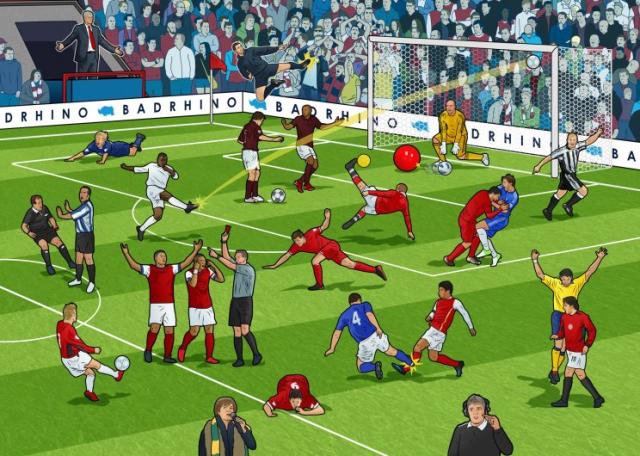
The rules are simple: one club, one Premier League season, 20 spots, one league. The goal? To create the best league of teams ever seen.
Go.
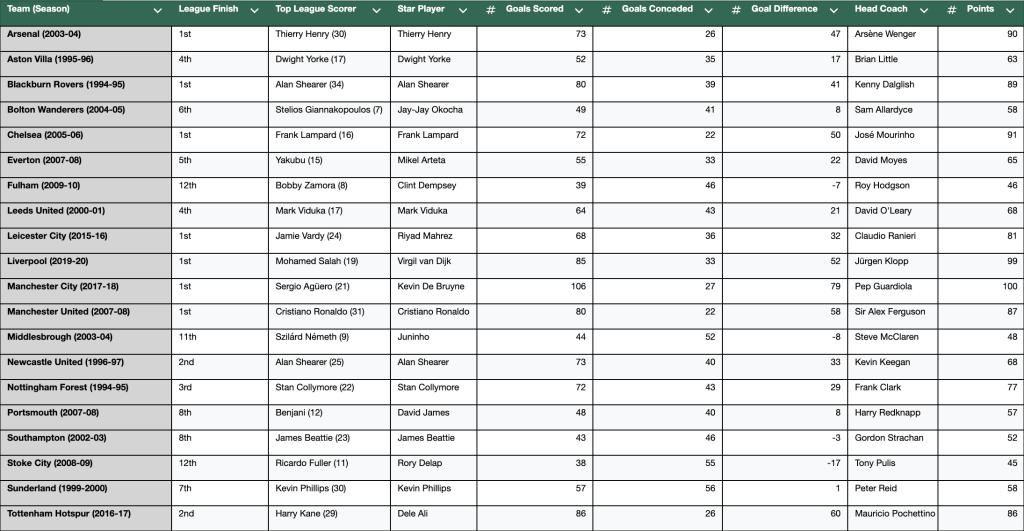
Arsenal (2003-04)
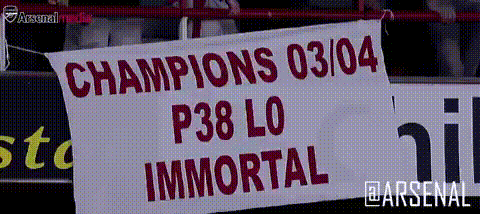
Not a bad way to kick off. The only team not to lose a game in single league season, Arsenal’s 2003-04 season is etched into Premier League history as the year of “The Invincibles.” Arsène Wenger’s side went the entire campaign unbeaten—a feat unmatched in the modern Premier League era. Thierry Henry was unplayable, scoring 30 league goals and earning the Golden Boot. Patrick Vieira bossed the midfield, while Sol Campbell and Kolo Touré anchored a resolute defence. The Gunners clinched the title with 90 points, ending the season 11 points clear of Chelsea. This legendary campaign cemented Arsenal’s legacy as one of the greatest teams of all time – one they have as yet failed to come close to emulating.
Aston Villa (1995-96)
Under Brian Little’s management, Aston Villa enjoyed a stellar 1995-96 campaign, finishing fourth and securing UEFA Cup qualification. Dwight Yorke was the talisman, scoring 17 league goals as Villa balanced attacking flair with defensive solidity. The season also saw Villa lift the League Cup after a 3-0 victory over Leeds United, marking their first silverware since 1982. Despite a competitive league, Villa proved they could mix it with the top teams, laying the groundwork for sustained success in the late 1990s.
Blackburn Rovers (1994-95)
Before Chelsea and Man City, there was Blackburn Rovers. Taken over in the 90s and flush with cash, the Rovers 1994-95 season culminated in Premier League glory, powered by the prolific partnership of Alan Shearer and Chris Sutton. Managed by Kenny Dalglish, Rovers edged a dominant Manchester United by a single point, finishing with 89 points to claim their first top-flight title since 1914. Shearer’s 34 goals led the league, while Tim Flowers (of Championship Manager 01-02 fame) and Colin Hendry provided defensive resilience. Though they lost on the final day to Liverpool, United’s draw against West Ham ensured the title went to Ewood Park, one of only two times the title wouldn’t go to Old Trafford between 1993-2001.
Bolton Wanderers (2004-05)
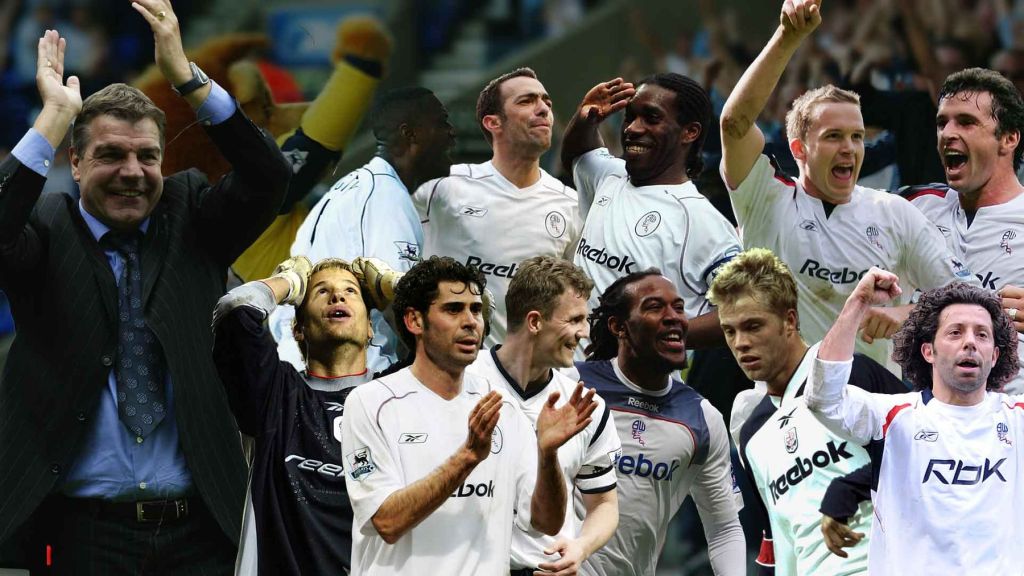
Vibes. That’s what’s behind a lot of these choices, and Sam Allardyce’s Bolton Wanderers side are no different. They defied expectations in 2004-05, finishing an impressive sixth and qualifying for the UEFA Cup. Known for their physicality and tactical pragmatism, the team was built around stalwarts like Jay-Jay Okocha and Stelios Giannakopoulos. Bolton were tough to beat, combining set-piece efficiency with a solid defense. A strong finish to the season, including a seven-match unbeaten run, ensured their European adventure for the following year. And they always beat Arsenal.
Chelsea (2005-06)
Chelsea’s dominance under José Mourinho for two seasons between 2004-2006 was incredible. I’ve chosen their 2005-06 team as they retained their Premier League crown with 91 points. The Blues boasted the league’s best defence, conceding just 22 goals, while Frank Lampard starred with 16 league goals. Key wins included a 4-1 demolition of Liverpool and a 3-0 victory over Manchester United. Chelsea’s relentless consistency ensured they finished eight points clear of second-placed United, solidifying their status as England’s dominant force. As would become a trend, Mourinho suffered ‘third season syndrome’ during 2007-2008 and departed the club in dramatic fashion.
Everton (2007-08)
David Moyes’ Everton team punched above their weight in the Premier League during the naughties, and I’ve chosen their 07/08 team which finished fifth with 65 points. This was in large part because Yakubu was the Toffees’ star man, netting 15 league goals, while Mikel Arteta pulled the strings in midfield. Everton’s defensive backbone, led by Joleon Lescott and Tim Howard, ensured they remained competitive throughout the season. Despite falling short of Champions League qualification, their Europa League berth highlighted Moyes’ ability to maximise the squad’s potential.
Fulham (2009-10)
Roy Hodgson’s Fulham side had a remarkable 2009-10 season, finishing 12th in the league but making headlines with a stunning run to the UEFA Europa League final. Bobby Zamora’s eight league goals complemented Clint Dempsey’s creativity, while Brede Hangeland was a rock in defense. Though they fell to Atlético Madrid in extra time in the final, Fulham’s European adventure captivated fans and remains a high point in the club’s history.
Leeds United (2000-01)
Leeds United are one of the tragic tales of the Premier League. They won the league in 1992 (the year before the Prem was founded) but was the ‘nearly boys’ during the 90s as rivals Manchester United got all the glory. The 2000-01 season saw David O’Leary’s young team combine domestic consistency with European excellence, and was largely their last hurrah before relegation followed in 2004. Mark Viduka scored 17 league goals, while Rio Ferdinand marshalled the defence. Leeds reached the semi-finals of the UEFA Champions League, falling to Valencia, but their fourth-place Premier League finish secured another season of European football.
Leicester City (2015-16)
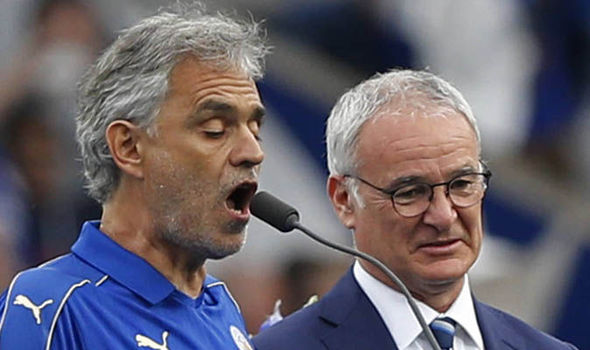
Who would leave them out? Leicester City’s 2015-16 season is arguably the greatest underdog story in football history. Under Claudio Ranieri, the Foxes defied 5000-1 odds to win the Premier League title with 81 points. Jamie Vardy’s 24 goals – and setting a new record of 12 consecutive games scored in row – Riyad Mahrez’s creativity, and N’Golo Kanté’s tireless work in midfield made Leicester bafflingly unstoppable. Their 3-1 victory over Manchester City and 1-0 win at Tottenham highlighted their credentials. The title was clinched with two games to spare, cementing Leicester’s fairy-tale season. To cap it off, Ranieri brought in opera singer Andrea Bocelli for the trophy ceremony. For this season alone, (and there isn’t much else to their credit) they make the 20.
Liverpool (2019-20)
Liverpool’s 2019-20 season under Jürgen Klopp ended their 30-year wait for a top-flight title. With 99 points, the Reds dominated the league, securing the title with seven games to spare – the earliest in Premier League history. Mohamed Salah led the scoring with 19 goals, while Virgil van Dijk and Alisson ensured defensive solidity. Key victories, including a 3-1 win over Manchester City, showcased their superiority. It’s a shame really that this momentous moment for Liverpool fans was overshadowed by the Covid-19 pandemic, but they make the 20 all the same.
Manchester City (2017-18)
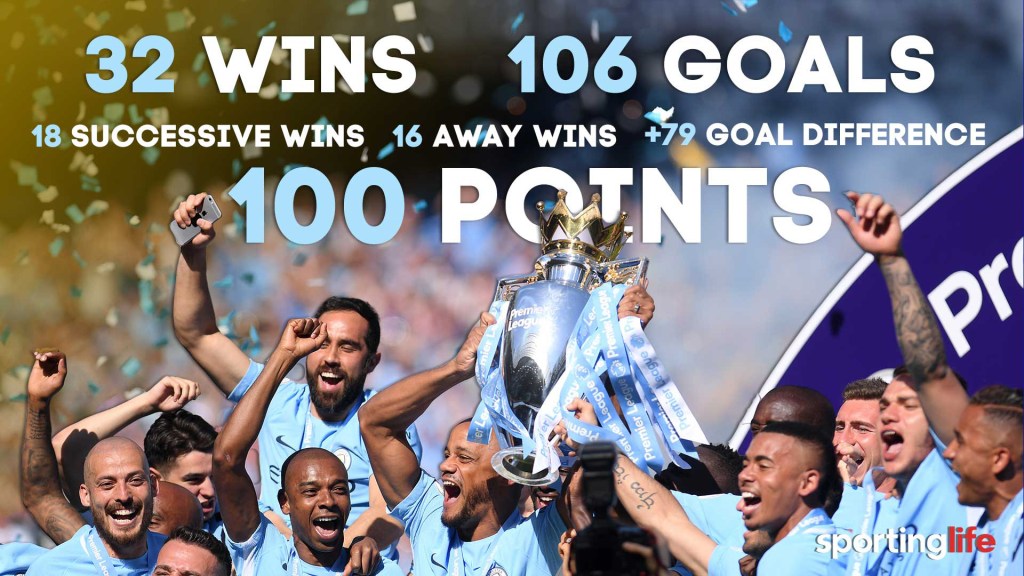
Pep Guardiola’s Manchester City redefined dominance in the Premier League during the 2017-18 season, becoming the first team to achieve 100 points. The “Centurions” broke numerous records, including most goals (106), most wins (32), and the largest winning margin (19 points). Kevin De Bruyne orchestrated the midfield, while Sergio Agüero and Raheem Sterling delivered the goals. City’s 5-0 thrashing of Liverpool and a 4-1 win over Spurs epitomised their attacking brilliance. Despite not having the romance of the Agueroooo moment in 2012, it’s undoubted that this campaign set a new benchmark for excellence in English football, and therefore can’t be ignored.
Manchester United (2007-08)
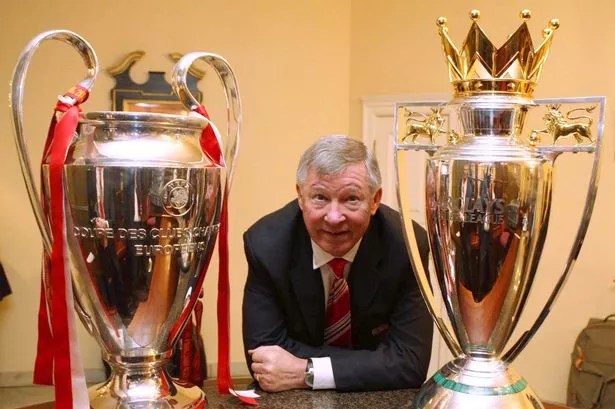
Perhaps the toughest choice of the 20, United were always going to make the list. The trouble is, which team? I’ve chosen Manchester United’s 2007-08 season because of several factors. Firstly, Cristiano Ronaldo. He lead the league in scoring 31 goals and is arguably the greatest player of all time. 2008 also marked United’s best defensive display, conceding just 22 goals, with the defensive partnership of Rio Ferdinand and Nemanja Vidić proving largely impenetrable. Sir Alex Ferguson’s side clinched the Premier League title with 87 points, not their largest total, but more than the 71 they got in 1999 (the other main contender to be included). Wayne Rooney and Carlos Tevez provided attacking support and United capped the season with a dramatic Champions League final victory over Chelsea on penalties, sealing a memorable double.
Middlesbrough (2003-04)
I decided early on that this league would have as many northern teams as possible. Middlesbrough’s 2003-04 season under Steve McClaren had more going for it than just geography though. It was a tale of mid-table stability and dramatic silverware triumph. Though they finished 11th in the league, their League Cup victory – a 2-1 win over Bolton – secured the club’s first-ever major trophy and UEFA Cup qualification. Juninho’s flair and Szilárd Németh’s goals highlighted their campaign, making it a landmark season for the Teessiders.
Newcastle United (1996-97)
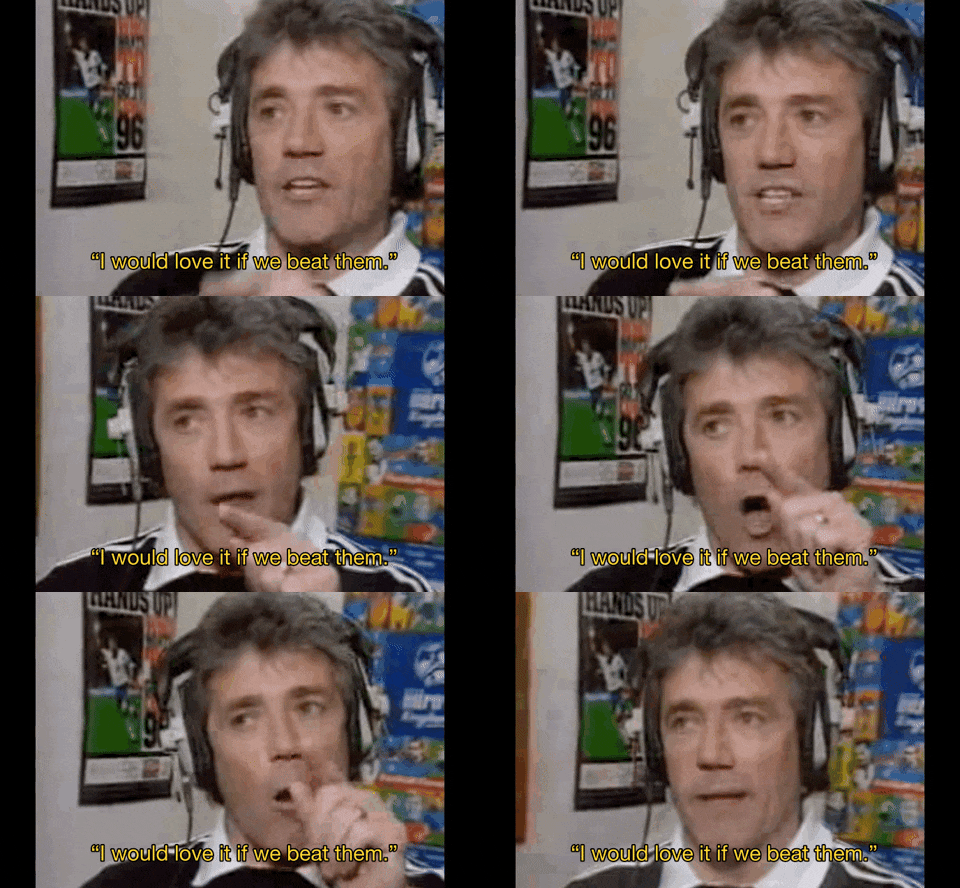
Perhaps the most box-office team in this list, Kevin Keegan’s “Entertainers” were at their thrilling best in the 1996-97 season. Newcastle finished second, just behind Manchester United, with Alan Shearer scoring 25 league goals after his world-record transfer. While they bottled the league, surrendering a 12pt lead to eventual winners Manchester United, iconic moments like a 5-0 demolition of United, showcased their attacking prowess. The Magpies’ exciting football and high league finish cemented their place as one of the era’s most beloved teams.
Nottingham Forest (1994-95)
Nottingham Forest’s 1994-95 campaign, led by Frank Clark, was a triumph for newly-promoted sides. Finishing third, Forest’s counter-attacking style, driven by Stan Collymore’s 22 goals, took the league by surprise. Memorable victories included a 2-1 win over Manchester United. Though they fell short of title contention, Forest’s success as a promoted team remains one of the Premier League’s standout stories. They’ve only come close to emulating ’95 very recently, currently sitting 2nd in Premier League at the time of writing. You never know…
Portsmouth (2007-08)
We couldn’t have the Ultimate Premier League without Harry Redknapp. His Portsmouth team had a season to remember in 2007-08. Though they finished eighth in the league, their FA Cup triumph – beating Cardiff City 1-0 in the final – secured European football for the first time in the club’s history. Benjani’s 12 league goals and David James’ heroics in goal were key to their success. Pompey’s balanced mix of flair and grit made them a team to watch.
Southampton (2002-03)
I know right? I didn’t imagine Southampton would be in this list either. But then I remembered James Beattie. Gordon Strachan’s Southampton side enjoyed a strong 2002-03 campaign, finishing eighth and reaching the FA Cup final. James Beattie was prolific, scoring 23 league goals – 2nd only to Ruud Van Nistelrooy – while a solid defensive unit kept them competitive. Though they lost the FA Cup final to Arsenal, the Saints’ league form ensured European qualification. It was one of Southampton’s most successful seasons in recent memory and entertaining to boot.
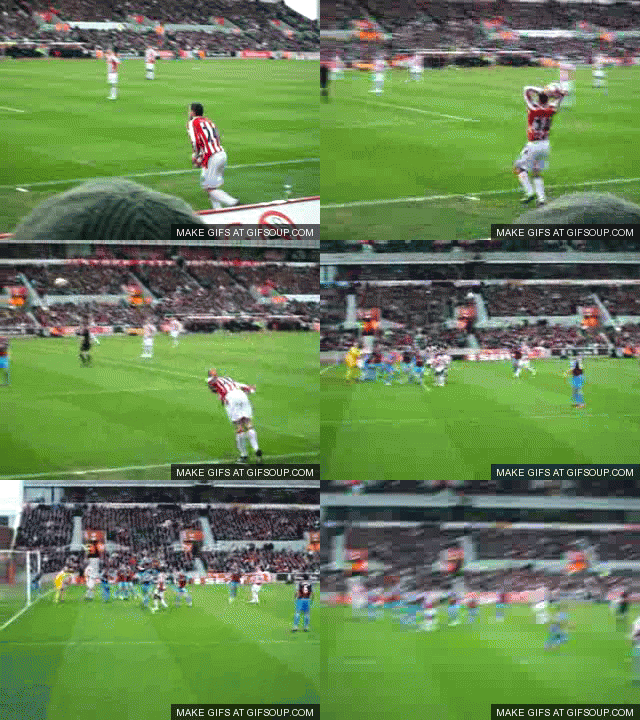
Stoke City (2008-09)
Rory Delap’s long-throw. That’s all.
Sunderland (1999-2000)
Sunderland’s 1999-2000 season, under Peter Reid, is included for one reason and one reason only: Kevin Phillips. He was unstoppable, netting 30 league goals to win the Golden Boot. Their high-energy style and strong home form, including a 2-1 win over Newcastle, made them a formidable force.
Tottenham Hotspur (2016-17)
Ah what might have been for Spurs. If Arsenal should have won the league in 2016, Spurs’ equivalent pivotal ‘moment’ was 2017. This was the year they should have done it. Mauricio Pochettino’s Spurs were a force to be reckoned with in 2016-17, finishing second with 86 points – their best-ever Premier League campaign. Harry Kane’s 29 goals and Dele Alli’s creative spark propelled them to victories like a 2-0 win over Arsenal in the final North London Derby at White Hart Lane. Though they fell short of Chelsea in the title race, Spurs’ stylish football and consistency cemented their status as title contenders and ultimately pipped their 2012 season with Gareth Bale. I mean, you couldn’t have Redknapp in twice… could you?
Honourable Mentions
West Ham United (2006-07)
West Ham – what a mess of a club. Though today they are largely soulless and uninspiring, West Ham’s 2006-07 season was a rollercoaster of emotions, culminating in an improbable escape from relegation. Managed first by Alan Pardew and later by Alan Curbishley, the Hammers endured a tough campaign. Controversy surrounded the signings of Carlos Tevez and Javier Mascherano added spice, with the former playing a pivotal role in their survival. Tevez scored crucial goals, including the winner on the final day against already crowned champions Manchester United, to secure a 1-0 victory and safety by the narrowest of margins. Despite off-field challenges and a 15th-place finish, this season is remembered as a dramatic triumph against the odds. For that, they nearly made the 20. Safe to say they would definitely not survived in this Ultimate Premier League.
Brighton & Hove Albion (2022-23)
Brighton are a modern day football marvel. When the Premier League was first founded in 1992, they were nowhere near – closer to going bust than going to Europe. The 2022-23 season was a landmark year for the club, as the enigmatic Roberto De Zerbi guided the Seagulls to a remarkable sixth-place finish and European qualification for the first time in their history. Known for their fluid, attacking football, Brighton were a joy to watch, with players like Kaoru Mitoma and Alexis Mac Allister shining. The emergence of World Cup winner Mac Allister and Evan Ferguson added an exciting edge to their squad. Key victories, such as a 3-0 demolition of Arsenal, showcased their credentials. Brighton’s European qualification highlighted their transformation from a mid-table side to genuine challengers. If it weren’t for the fact their success is so recent and therefore doesn’t have the same romance about it, I would definitely have included them.
 Off The Post
Leave a comment